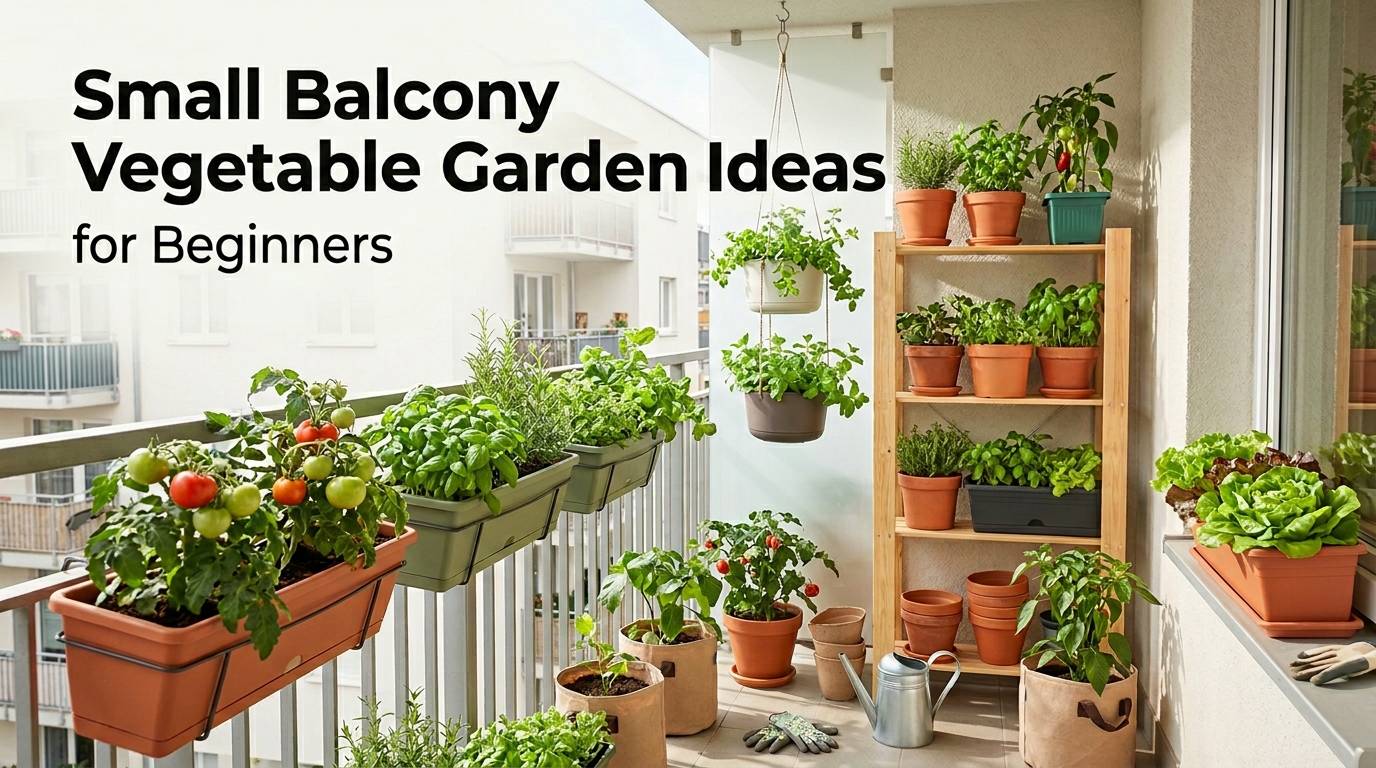
There is something genuinely remarkable about walking out onto your apartment balcony, snipping a few leaves of fresh basil, pulling a ripe cherry tomato from a vine you planted yourself, and bringing it all back inside to a meal. It costs almost nothing once you are set up, it connects you to the rhythm of growing things in a way that no store purchase ever quite replicates, and it is far more achievable than most apartment dwellers realize.
I have worked with urban homeowners and apartment renters who were convinced that growing food was something you needed a yard for. In almost every case, once we assessed their balcony conditions and matched the right plants to the right containers and light exposure, they were harvesting fresh vegetables within a single season. Sometimes within a matter of weeks.
These small balcony vegetable garden ideas are written specifically for beginners: people who have never grown food before, people who are working with very limited outdoor space, and people who want practical, honest guidance rather than aspirational gardening content that glosses over the real conditions of apartment living. If you have a balcony, access to sunlight for at least four hours a day, and a willingness to water consistently, you have everything you need to start.
Can You Really Grow Vegetables on a Small Apartment Balcony?
Yes, and more successfully than you might expect. Many of the most productive and beginner-friendly vegetables are well-suited to container vegetable gardening in small outdoor spaces. Cherry tomatoes, salad greens, herbs, radishes, green onions, peppers, and dwarf bean varieties all thrive in containers on a balcony with adequate sunlight. The keys are matching your plant selection to your specific light conditions, choosing the right container sizes, and establishing a consistent watering routine.
1. Assess Your Balcony Light Before Buying a Single Plant
Every piece of advice in this article rests on one foundational step that many beginners skip entirely: honestly observing and measuring how much direct sunlight your balcony receives and at what times of day.
Most vegetables need a minimum of six hours of direct sunlight per day to produce a meaningful harvest. Some, like salad greens, spinach, and herbs such as parsley and mint, will manage on four to five hours of partial sun. But fruiting vegetables like tomatoes, peppers, cucumbers, and beans need that full six hours or more to flower and set fruit reliably.
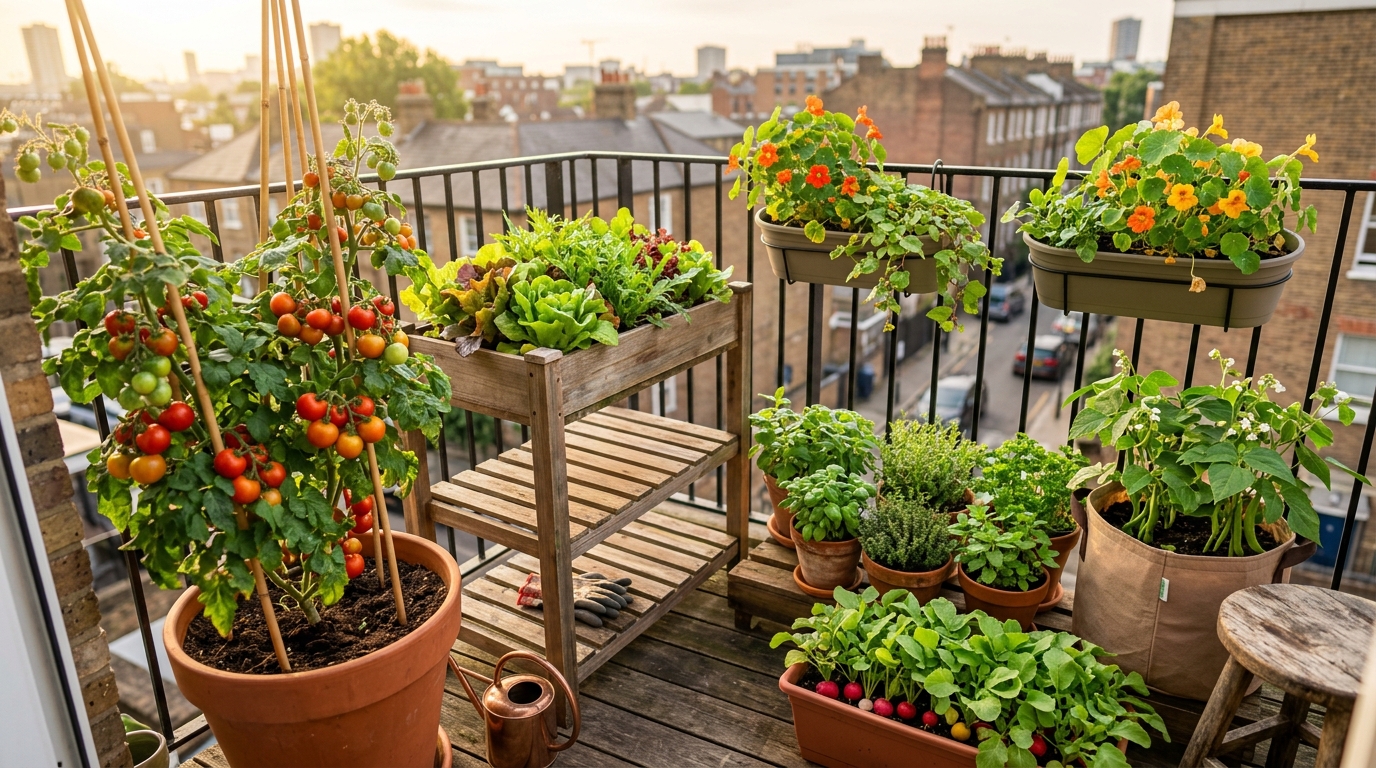
Spend two or three days before purchasing anything observing your specific balcony. Note when direct sun hits the space, how long it stays, and whether any part of the balcony receives more light than others. South and west-facing balconies in the northern hemisphere receive the most sunlight and are best suited to the widest range of vegetables. North and east-facing balconies receive less direct sun and are better suited to leafy greens and herbs that tolerate partial shade.
Matching your balcony vegetable plants to your actual light conditions is the single most important factor in determining whether your first season is a success or a disappointment.
2. Start With Cherry Tomatoes as Your Anchor Crop
If you grow only one vegetable on your balcony this season, make it cherry tomatoes. They are arguably the most rewarding balcony vegetable plant for beginners because they are forgiving, productive, visually dramatic, and genuinely delicious in a way that supermarket tomatoes rarely match.
Cherry tomato varieties specifically bred for container growing include Tumbling Tom, which cascades beautifully over the edges of hanging baskets and large pots, Tiny Tim, which stays compact at around twelve inches tall, and Sun Gold, which produces extraordinary quantities of sweet orange fruit on a manageable plant.
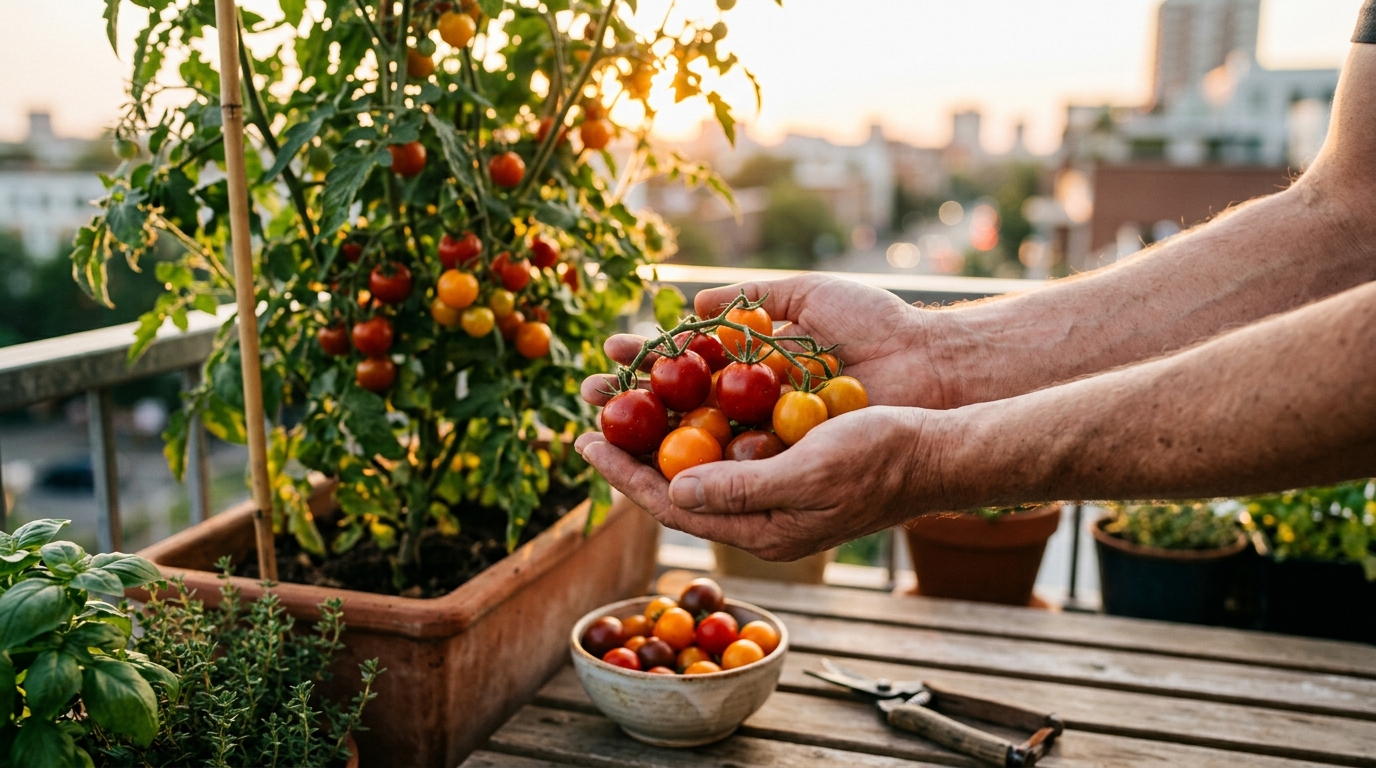
Plant cherry tomatoes in containers of at least twelve inches in diameter and twelve inches deep, using a rich potting mix with a slow-release fertilizer incorporated at planting. Provide a simple stake or small tomato cage for upright varieties to climb. Water consistently, keeping the soil evenly moist rather than alternating between very wet and very dry, which causes the fruit skins to split.
In a good season on a sunny balcony, a single well-tended cherry tomato plant will produce more fruit than you can keep up with. It is one of the most satisfying entries into apartment vegetable gardening available to a beginner.
3. Grow a Continuous Salad Greens Container
A large container planted with a mix of salad greens is one of the most practical and immediately rewarding small balcony vegetable garden ideas for beginners. Salad greens grow quickly, tolerate partial shade better than most vegetables, and can be harvested continuously using the cut-and-come-again method, which means a single planting produces multiple harvests over weeks or even months.
Choose a wide, shallow container of at least fourteen inches in diameter and six to eight inches deep. Fill it with a quality potting mix and sow a mixture of seeds directly onto the surface: loose-leaf lettuce varieties, arugula, spinach, and baby kale all work beautifully together and mature at similar rates.
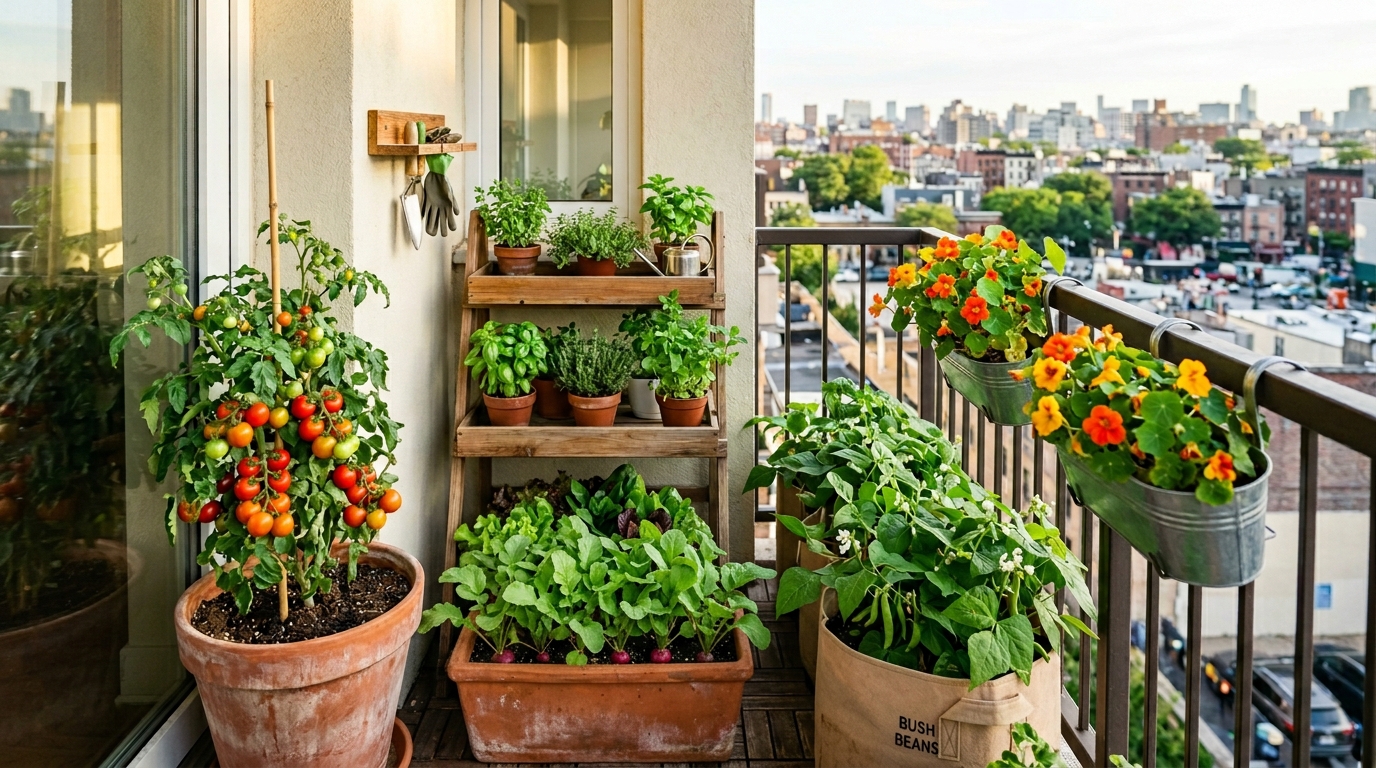
Once the plants reach three to four inches tall, begin harvesting by cutting the outer leaves with scissors, leaving the central growing point intact. New leaves will replace what you have harvested within one to two weeks in warm growing conditions. Succession sow a new container every three to four weeks through the growing season for a continuous supply of fresh salad greens throughout spring and fall.
4. Dedicate a Container to Fresh Herbs
A dedicated herb container is not technically a vegetable garden. Still, it belongs in every apartment vegetable garden setup because it delivers daily culinary value from the smallest possible space investment. A single large container planted with five to seven culinary herbs provides fresh flavoring for meals year-round and looks beautiful on any balcony.
The most useful culinary herbs for a beginner’s balcony herb garden include basil, flat-leaf parsley, chives, thyme, rosemary, oregano, and mint. A critical practical note: always keep mint in its own separate container. It spreads aggressively through shared soil and will crowd out every other plant given the opportunity.
Most herbs are available as small seedlings from garden centers and grocery stores for one to three dollars each, making the initial investment minimal. Many also grow easily from seed for even less. Harvest herbs regularly by snipping stems just above a leaf node, which encourages the plant to branch and become bushier rather than leggy and sparse.
5. Try Radishes for Fast, Satisfying Results
If you want the fastest possible validation that you can actually grow food on your balcony, plant radishes. Most varieties go from seed to harvest in twenty to thirty days, which means you can sow seeds on a Saturday morning and be pulling your first homegrown vegetables within a month.
Radishes require minimal depth, performing well in containers as shallow as six inches, and they tolerate partial shade better than most root vegetables. Sow seeds directly into moist potting mix about half an inch deep and one inch apart, thin to two inches apart once seedlings emerge, and water consistently. Harvest when the shoulders of the radish are visible just above the soil surface.
Succession sow a new small container of radishes every two weeks through spring and fall for a continuous supply. They are one of the most beginner-friendly balcony vegetable plants available and provide a genuine confidence boost for anyone new to food growing.
6. Grow Green Onions From Scraps
Green onions are among the most practical and genuinely zero-cost crops a beginner can grow on a balcony, because they can be started entirely from kitchen scraps rather than seeds or seedlings.
Save the white root ends from a bunch of store-bought green onions, leaving approximately one inch of white stem attached to the roots. Place them upright in a container of potting mix, water gently, and position in a spot with at least partial sun. Within a week, green shoots will emerge from the cut tops. Within two to three weeks, the green onions will be at harvestable size again.
Cut the green tops as needed, leaving the root intact to regrow. A single set of root ends will regrow multiple times before eventually losing vigor. This is one of the most satisfying demonstrations of how container vegetable gardening can genuinely produce food for almost no cost at all.
7. Plant Dwarf or Bush Bean Varieties
Beans are one of the most productive vegetables relative to the space and effort they require, and dwarf or bush bean varieties are specifically suited to small balcony vegetable garden ideas because they stay compact without needing the vertical support that climbing pole beans require.
Bush bean varieties like Provider, Contender, and Tendergreen grow to approximately eighteen inches tall and produce a concentrated flush of pods over two to three weeks. Plant seeds directly in a container of at least twelve inches in diameter and ten inches deep, spacing seeds two to three inches apart. Water consistently, and the plants will produce a generous harvest with minimal intervention.
For a continuous supply rather than a single concentrated harvest, succession plant a new container of beans every two to three weeks through the growing season. Beans also fix nitrogen in the soil as they grow, which is a genuine benefit for the long-term health of your container potting mix.
8. Try Compact Pepper Varieties
Peppers, both sweet and hot varieties, are among the most ornamental balcony vegetable plants available because the fruits are as visually beautiful as they are edible. Compact varieties specifically bred for container growing, such as Lunchbox peppers, Pot-a-Peno, and Mohawk sweet peppers, grow to manageable heights of twelve to eighteen inches and produce abundantly in containers.
Peppers need more heat than most vegetables to thrive, which makes them particularly well-suited to south or west-facing balconies that receive full afternoon sun. They also benefit from consistent warmth at the root zone, so positioning their containers against a sun-warmed wall or railing amplifies productivity. Water when the top inch of soil feels dry and feed with a balanced liquid fertilizer once the first flowers appear.
A single compact pepper plant on a warm balcony will produce fruit from midsummer through the first frost of autumn, making it one of the longest-producing crops in any apartment vegetable garden.
9. Build a Simple Tiered Vegetable Growing Setup
Vertical space is the most underused resource on any small balcony, and a simple tiered growing setup multiplies your productive capacity dramatically without increasing your floor footprint. This is one of the most impactful structural small balcony vegetable garden ideas available to a beginner working with limited outdoor space.
A basic tiered setup can be created from a commercially available three or four-tier plant stand, a set of wooden crates stacked at different heights, or a freestanding shelving unit rated for outdoor use. Position the tallest plants at the back or top of the tier, mid-height plants in the middle, and compact or trailing varieties at the lower levels.
A practical tiered arrangement for a beginner might include cherry tomatoes in a large container at the upper level catching maximum sun, a salad greens container at mid level, herbs in the tier below, and radishes or green onions at the lowest level. This single structure could support the majority of a functional beginner apartment vegetable garden in a footprint of less than two square feet of floor space.
10. Choose the Right Containers for Each Crop
Container vegetable gardening success depends heavily on matching the right container size to the specific crop being grown. Containers that are too small restrict root development, dry out too quickly, and limit productivity significantly. Using the correct size from the start is one of the most important practical decisions a beginner can make.
A reliable size guide for common balcony vegetables:
Salad greens and herbs perform well in containers of six to eight inches deep and twelve inches or more in diameter. Radishes, green onions, and shallow-rooted crops need six to eight inches of depth. Bush beans, compact peppers, and dwarf eggplant need containers of ten to twelve inches deep and at least twelve inches in diameter. Cherry tomatoes need a minimum of twelve inches deep and twelve inches in diameter, with larger ones being significantly better. Full-sized peppers, cucumbers, and larger tomato varieties need containers of fifteen to twenty gallons or more for optimal productivity.
Regarding material, lightweight fabric grow bags are excellent for beginners because they promote healthy root development through air pruning, prevent overwatering through permeable walls, are inexpensive, and fold flat for off-season storage. Plastic containers retain moisture well and are lightweight. Terracotta is beautiful but dries out quickly and adds significant weight to a balcony, which may be a concern on structures with load restrictions.
11. Set Up a Simple Watering Routine
Inconsistent watering is the single most common reason beginner container vegetable gardens fail, and it is entirely preventable with a small amount of planning and routine.
Container vegetables need water more frequently than in-ground plants because the limited soil volume dries out faster, especially in warm weather and on exposed sunny balconies. As a general starting guideline, check containers daily by pressing a finger one inch into the soil. If it feels dry at that depth, water thoroughly until water runs from the drainage holes. If it still feels moist, wait and check the following day again.
During peak summer heat, some containers on a south-facing balcony may need water twice daily. In cooler weather or during periods of cloud cover, every two to three days may be sufficient. Learning to read the actual moisture level of your specific containers in your specific conditions is a skill that develops quickly over the first few weeks of gardening and becomes largely intuitive.
Self-watering containers with built-in water reservoirs are a practical investment for beginners who travel frequently or find consistent daily watering difficult to maintain. They do not eliminate the need for monitoring but significantly extend the interval between waterings, reducing the risk of plants drying out during a busy period.
12. Feed Container Vegetables Regularly
Unlike in-ground garden plants that can access nutrients from a wide root network in native soil, container vegetables are entirely dependent on what is present in their limited potting mix. Nutrients in potting mix are depleted relatively quickly through regular watering and plant uptake, which means container vegetables need regular supplemental feeding to perform at their best.
For beginners, the simplest approach is to incorporate a slow-release granular fertilizer into the potting mix at planting time, following package instructions for quantity. This provides a baseline of nutrients for the first two to three months without requiring any additional intervention.
From the point at which plants begin flowering, or once the slow-release fertilizer is nearing the end of its stated duration, supplement with a liquid fertilizer applied every one to two weeks. A balanced general-purpose liquid feed works well for leafy greens and herbs. Once tomatoes, peppers, and other fruiting crops begin to flower, switch to a feed higher in potassium to support fruit development rather than continued leafy growth.
13. Manage Pests Without Harsh Chemicals
Even on a high-rise apartment balcony, container vegetables attract pests. Aphids, spider mites, fungus gnats, and whiteflies are the most common problems in balcony container gardens, and all can be managed effectively without resorting to harsh chemical pesticides that are inappropriate and potentially harmful in a small enclosed outdoor space.
Aphids, which cluster on new growth and the undersides of leaves, respond well to a direct blast of water from a spray bottle or a diluted solution of mild dish soap and water applied to affected areas. Spider mites thrive in hot, dry conditions and are best prevented by keeping plants well-watered and occasionally misting the foliage. Fungus gnats breed in consistently wet, poorly draining soil, which means the most effective prevention is allowing the top inch of soil to dry between waterings rather than keeping it perpetually moist.
From a sustainable design perspective, avoiding pesticide use on a balcony vegetable garden is important not only for the health of the food you are growing but for the broader urban ecosystem. Balcony gardens, even small ones, contribute to urban biodiversity and provide habitat for pollinators. Keeping them chemical-free supports that contribution.
Common Beginner Vegetable Garden Mistakes to Avoid
Overcrowding containers is the most universal beginner mistake. It is tempting to fit as many plants as possible into each pot to maximize productivity. Still, overcrowded plants compete for water, nutrients, and light, and ultimately produce less than well-spaced plants in appropriately sized individual containers. Follow spacing recommendations on seed packets and plant labels without compromise.
Ignoring drainage is a critical structural error. Every container must have adequate drainage holes, and those holes must not be blocked by the container sitting flush on a flat surface. Raise containers slightly on pot feet or small wooden blocks to ensure water drains freely. Waterlogged soil causes root rot quickly in container vegetables and is almost always fatal to the plant.
Planting too early in the season is an enthusiasm-driven mistake that many beginners make. Most vegetables cannot tolerate frost, and even cold nights significantly slow growth and stress young plants. Check your local last frost date before planting warm-season crops outside, and wait until nighttime temperatures are consistently above fifty degrees Fahrenheit before putting tomatoes, peppers, beans, and other warm-season vegetables outdoors.
A Note on Sustainable Balcony Food Growing
Growing even a small portion of your own food on an apartment balcony has genuine environmental benefits beyond the obvious. It reduces packaging waste from store-bought produce, eliminates the transportation emissions associated with that produce, and, in the case of organically managed container gardens, keeps harmful agricultural chemicals out of the urban water system.
As a LEED Green Associate, I always encourage apartment dwellers to think of a balcony vegetable garden not just as a food source but as a contribution to a healthier urban environment. Even a small collection of containers producing cherry tomatoes, salad greens, and herbs represents a meaningful step toward a more self-sufficient and sustainably minded way of living in a city.
Final Thoughts on Small Balcony Vegetable Garden Ideas
A balcony vegetable garden does not need to be large, elaborate, or expensive to be genuinely rewarding. A single cherry tomato plant, a container of salad greens, and a pot of herbs planted on a sunny balcony will produce real food, real satisfaction, and the beginning of a relationship with growing things that tends to expand season by season.
The best small balcony vegetable garden ideas for beginners are the ones that start simple, match the actual conditions of the space, and build confidence through early success. Assess your light, choose your first three crops, get the containers and potting mix right, and establish a watering habit. Everything else follows naturally from there.
Start this weekend. By next month, you will be harvesting something from your own balcony garden, and that first taste will make the whole effort feel entirely worthwhile.
FAQ: Small Balcony Vegetable Garden Ideas for Beginners
What are the easiest vegetables to grow on a small balcony?
Radishes, salad greens, green onions, cherry tomatoes, and herbs are consistently the most beginner-friendly balcony vegetable choices. Radishes in particular offer the fastest results, going from seed to harvest in as little as twenty to thirty days. Salad greens are forgiving, tolerate partial shade, and can be harvested continuously over many weeks from a single sowing.
How much sunlight does a balcony vegetable garden need?
Most fruiting vegetables, including tomatoes, peppers, and beans, require a minimum of six hours of direct sunlight per day. Leafy greens, herbs, and root vegetables like radishes can manage on four to five hours of partial sun. Always assess your specific balcony light conditions before selecting plants, as mismatching plants to light exposure is the most common cause of balcony garden failure.
What is the best potting mix for container vegetable gardening?
Use a high-quality, lightweight potting mix formulated specifically for containers rather than garden soil, which compacts in pots and drains poorly. Look for a mix containing perlite or vermiculite for improved drainage and aeration. Incorporate a slow-release granular fertilizer at planting to provide a baseline of nutrients through the early growing period.
How do I prevent my balcony container vegetables from drying out?
Check containers daily during warm weather by pressing a finger one inch into the soil. Water thoroughly when dry at that depth. Self-watering containers with built-in reservoirs extend the interval between waterings significantly. Grouping containers together so they shade each other’s root zones also helps retain soil moisture, as does placing containers out of the strongest midday wind exposure.
Can I grow vegetables on a balcony with only partial shade?
Yes, but your crop choices will be more limited. Leafy greens, including lettuce, spinach, arugula, and kale, perform well in partial shade and are among the most productive shade-tolerant balcony crops. Herbs like parsley, mint, chives, and cilantro also tolerate lower light conditions. Fruiting crops like tomatoes, peppers, and cucumbers need full sun and will not produce reliably in a shaded location.