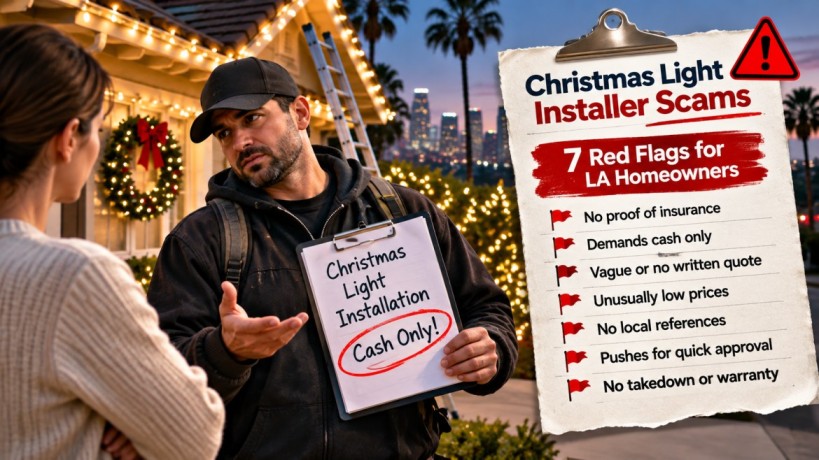
Every November, Los Angeles picks up a second seasonal workforce. Not the mall elves. The crews with a ladder, a pickup truck, and an Instagram page promising to outline your roofline in lights by Saturday. Most of them are exactly who they say they are. A few aren’t, and the difference usually shows up after you’ve paid.
Consumer groups have heard the same complaints for years: deposits collected and lights never hung, displays that go up crooked and die by mid-December, strands still dangling off the gutter come April. This guide covers the most common Christmas light installer scams, what hiring holiday lighting contractor crews should look like when it goes right, and the seasonal contractor red flags worth walking away from. Where California rules apply, we checked them against the Contractors State License Board (CSLB).
One honest caveat first. An installer without a state license isn’t automatically a fraud, and a license doesn’t guarantee good work. Treat everything below as patterns to watch, not verdicts.
Why Holiday Lighting Attracts Sloppy (and Shady) Operators
The setup invites trouble. Demand explodes over a few weeks. Startup costs are low: a ladder, some clips, a few hundred feet of lights. Customers are rushed, often booking after Thanksgiving when the best crews are already full. And newcomers have no track record to lose. Christmas light installer scams thrive on that speed. Browse a home-services directory for holiday lighting in LA and you’ll find listings the platform itself tags as unlicensed contractors.
The licensing rules are worth a minute of your attention. California requires a CSLB license for work valued at $1,000 or more in labor and materials, a threshold that rose from $500 on January 1, 2025. The small-job exemption covers someone working alone on a project under that amount with no permit needed. Bring on workers or trigger a permit and it no longer applies. Whether a simple clip-on roofline counts as contracting work can be debatable. Wiring isn’t debatable: add outlets in your eaves or tie a permanent system into your panel and you’re in C-10 electrical contractor territory.
7 Seasonal Contractor Red Flags to Watch For
1. No License Number, or One That Doesn’t Check Out
Ask for the CSLB license number before you ask for a price. A real contractor reads it off without blinking, and it usually appears on their contract and advertising.
Watch for two variations. The first is the breezy “we’re fully licensed and insured” that never comes with an actual number. The second is a number that belongs to somebody else. CSLB sting operations have led to felony charges for illegally using a license number, so it happens.
A small solo job under $1,000 might legally need no license at all. That doesn’t make a false claim of being licensed any less of a lie, and it takes two minutes to catch.
2. They Want Most or All of the Money Up Front
Deposits are normal. Big deposits aren’t. CSLB’s rule for home improvement contracts caps a down payment at $1,000 or 10 percent of the price, whichever is smaller, and says payments should follow the work actually completed. Whether a seasonal lighting job counts as a home improvement contract under state law depends on the scope, but the cap is still the best yardstick you’ve got. If a crew wants half the bill before a single clip goes up, or insists on cash, they’re asking you to carry all the risk.
The Better Business Bureau serving Houston and South Texas reports complaints every year about installers who took payment and then failed to hang or remove the lights. Their advice: pay by credit card, pay at completion where possible, and handle takedown as a separate payment. A card gives you a dispute option. Cash, Zelle, and Venmo give you a story to tell your friends.
3. There’s No Written Contract, or It Says Almost Nothing
A text reading “ok see you Saturday” is not a contract. CSLB advises putting everything you’ve asked for in writing, because spoken promises are hard to enforce. A usable agreement for holiday lighting spells out:
- Measured footage and the areas covered (roofline, windows, trees, railings)
- Light type, color, and who owns the lights
- An install date and a takedown date
- What happens when strands fail mid-season
- The total price and when each payment is due
- Cancellation terms
Takedown dates matter more than people expect. The same Houston-area BBB has heard from customers whose lights were never taken down. Put the date in writing.
One more protection: if you sign a qualifying home improvement contract at your home, California gives you three business days to cancel, five if you’re 65 or older. The notice must be in writing and mailed before midnight on the third day. Ask whether your agreement includes that notice. A contractor who dodges the question is telling you something.
4. They Won’t Show Proof of Insurance
Ladders, steep roofs, and live electrical connections make a risky combination, and LA has no shortage of hillside lots. Ask for certificates showing general liability and workers’ compensation, then call the insurer to confirm the policies are active. That’s BBB guidance, and it’s worth the ten minutes. The City of Claremont has publicly reminded residents to verify business licenses, liability insurance, and workers’ comp before hiring holiday light installers. Uninsured crews put you at risk of being the one left sorting out the bills after an accident.
5. They Push You to Decide Today
Door-knockers offering a discount if you sign now. A crew that’s “already in your neighborhood” with spare lights on the truck. A vehicle with no company name. BBB guidance is blunt: pressure is a warning sign, and you shouldn’t sign anything until you’ve had time to research the company. CSLB adds two rules for contracts that carry a cancellation right: don’t let work begin during the cancellation window, and don’t agree to waive the right because someone claims there’s a rush. A legitimate company will still be there tomorrow. Say you’ll call back, then run the lookup below.
6. The Price Is Suspiciously Low, or Keeps Changing
One Southern California cost guide puts typical professional installation at roughly $2.50 to $5.00 per linear foot, with typical totals running $240 to $650. Your home will land somewhere on that spectrum depending on roof pitch, stories, and extras. Quotes far below it are classic bait. The headline number shows up, then come the add-ons: a “tall house” charge, extra for clips, extra for takedown.
Insist on an itemized quote with measured footage, and be wary of any figure given over the phone by someone who never looked at your house. A very high quote isn’t proof of quality either. Get three and compare them line by line.
7. You Can’t Verify They’re a Real, Local Business
Scammers and flaky amateurs share one trait: they’re hard to find later. Look for a business name that matches the license and insurance, a verifiable local presence, and reviews that span months or years across more than one site instead of twenty five-star posts from last week.
In the City of Los Angeles, anyone doing business must register and pay business tax, so ask for the Business Tax Registration Certificate. Other LA County cities run their own business license programs. Ask for two recent customers you can call. Then search the company name next to the word “complaint.” Ohio’s attorney general recommends that exact trick, and it works in any state.
Check Contractor License California: The Five-Minute Lookup
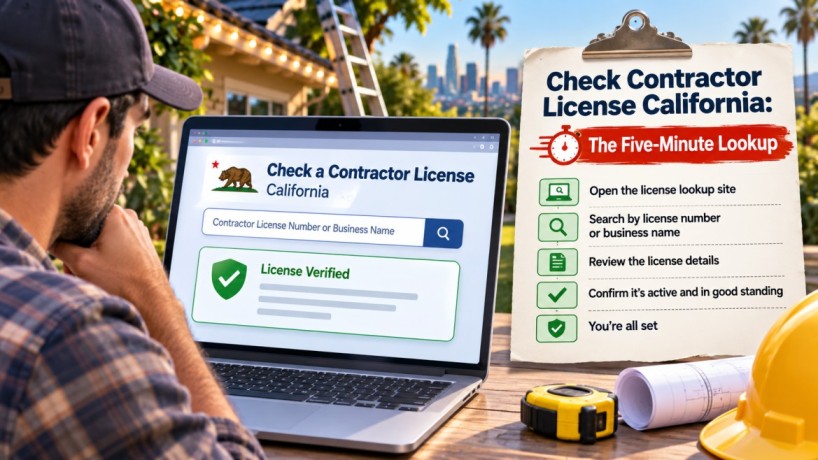
It takes about five minutes to check contractor license California records, and it’s the single most useful thing in this article. Here’s the fast version:
- Get the exact business name and CSLB license number in writing or by text.
- Open CSLB’s Check A License tool at cslb.ca.gov (or CheckTheLicenseFirst.com) and search by license number.
- Confirm the status is active and the classification fits the job. Electrical work belongs to a C-10.
- Read the bond and workers’ compensation details on the record, plus any citations or disciplinary actions. CSLB publishes complaints that end in citations or formal accusations.
- Match the business and personnel names to the people at your door. A real license under a different name is a red flag, not a pass.
- Still unsure? Call CSLB at (800) 321-CSLB (2752).
Quick Pre-Hire Cheat Sheet
| Ask | Good answer | Walk away if |
| What’s your CSLB license number? | A number that checks out and matches the business name | Vague claims, or a number belonging to someone else |
| Can you send proof of insurance? | General liability and workers’ comp certificates you can verify by phone | “We’re covered” with no paperwork |
| How much do you need up front? | A modest deposit, balance after the work, cards accepted | Half or more, cash or apps only |
| When do the lights come down? | A written takedown date and price | “We’ll work it out later” |
| Can I call recent customers? | Names and phone numbers | Excuses |
If You’ve Already Paid a Bad Installer
Move quickly and keep paper. Save photos of the work, texts, receipts, and the contract. Send a written demand with a deadline. If you paid by card, contact the issuer early about disputing the charge. Report the company to CSLB at (800) 321-CSLB, check LA County’s Department of Consumer and Business Affairs for current complaint options, and file a report with BBB Scam Tracker. Reports build the public record that helps your neighbors avoid the same crew.
Final Thoughts on Hiring a Holiday Lighting Contractor in LA
Hiring a holiday lighting contractor doesn’t have to feel like a gamble. The formula is boring, which is why it works: verify the license number, confirm the insurance, get everything in writing, pay in stages by card, and put the takedown date in the contract.
Do it in October or early November, before the post-Thanksgiving scramble when the good crews are booked and rushed decisions get made. The lights will go up either way. You decide whether the season ends with a glowing roofline or a stack of unreturned calls.