Every year, somewhere around late October, the same conversation happens in households across the country. Someone opens the garage, pulls out a box of tangled Christmas lights, squints at the label, and asks: are these the good ones or the bad ones?
If you are standing in the holiday lighting aisle trying to decide between icicle lights and C9 bulbs, you are in the right place. These are the two most popular choices for exterior home lighting during the holiday season and they could not be more different in the effect they produce, the homes they suit best, and the practical realities of installing and living with them.
Neither is universally better. They just do different things. Here is exactly what you need to know to make the right call for your specific home.
What Are Icicle Lights?
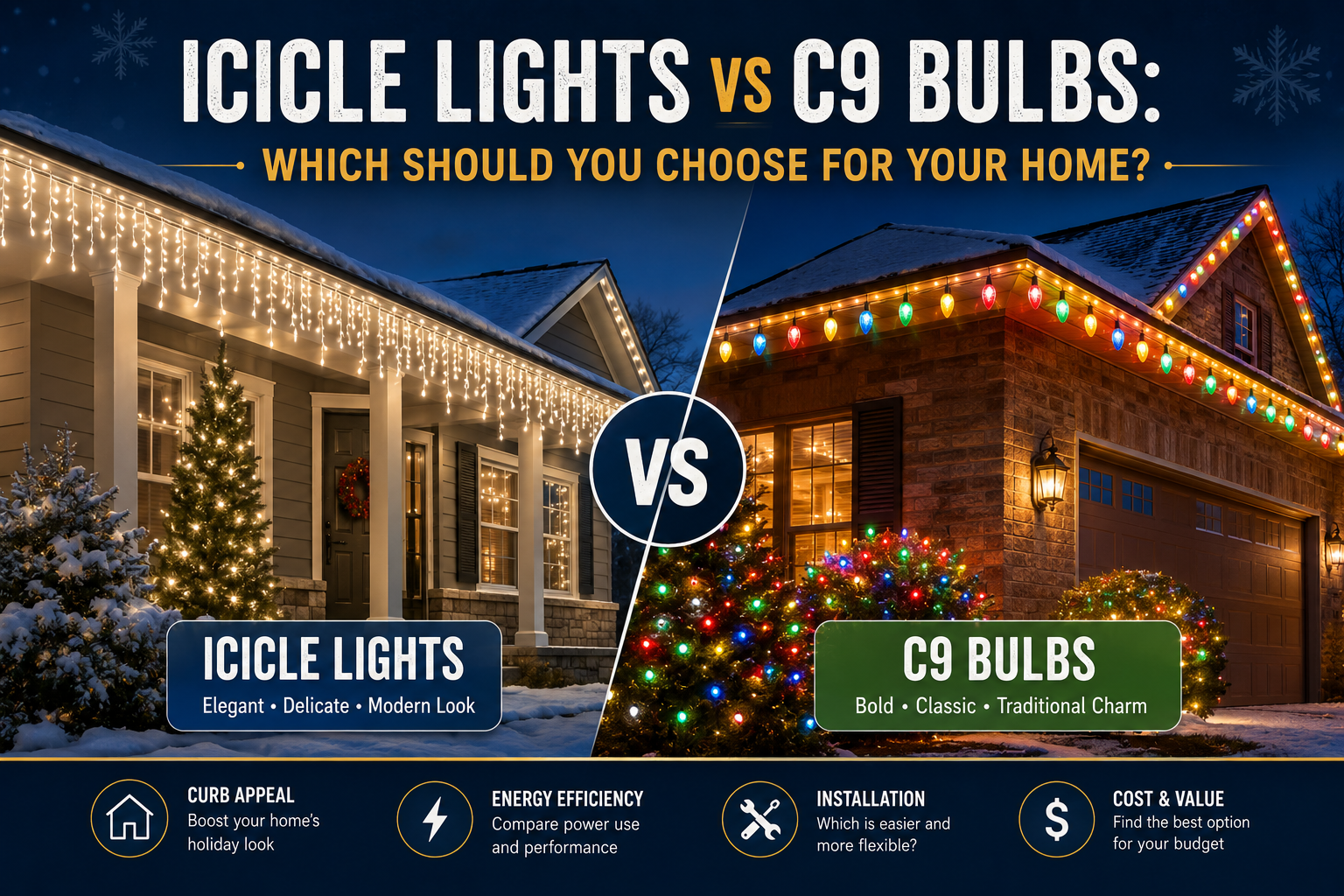
Icicle lights hang vertically from a horizontal strand, creating a cascading curtain effect that mimics the look of frozen water dripping from a roofline. They are installed along eaves, gutters, or porch ceilings and drop typically between nine and eighteen inches below the mounting point.
The visual effect is soft, atmospheric, and distinctly wintery. One mimics the delicate draping of frozen waterfalls along rooftops, which is exactly the appeal. When lit in cool white, icicle lights read less as Christmas decoration and more as a genuinely winter scene, something that suits certain home styles and certain aesthetic preferences far better than the traditional holiday look.
The practical advantages of icicle lights include their long lifespan. LED icicle lights are often rated for 25,000 to 50,000 hours, making them ideal for homeowners who value sustainability and low maintenance. They are also relatively easy to install since the main strand runs horizontally along the roofline with the drops hanging freely rather than needing to be individually positioned.
Their limitation is context. In areas with heavy snowfall or strong winds, icicle lights may become obscured or damaged. Additionally, because they rely on density and proximity for visual impact, they are best suited for close-range viewing, such as porches, entryways, or front-facing eaves, rather than large-scale exterior transformations.
What Are C9 Bulbs?
C9 bulbs are the large, classic, individual bulbs you associate with the kind of Christmas lighting that can be seen from two streets away. C9 bulbs are larger, standalone lights, typically measuring around 1.5 inches in diameter, with a classic Edison-style shape. Traditionally used in commercial and municipal displays, they deliver high lumens per bulb, making them highly visible even from a distance.
C9 bulbs are typically sold in 12.5 or 25-foot strands with bulbs spaced approximately 12 inches apart. This wider spacing works well for outlining rooflines, draping across tree branches, or creating vertical lines on pillars.
The LED versions of C9 bulbs have transformed the energy equation significantly. Incandescent C9 bulbs use 5 to 7 watts per bulb, while LED versions consume much less power at 0.5 to 0.74 watts per bulb. That is a reduction of roughly 90 percent in energy consumption while delivering equal or better brightness, which matters if you are running a display for six to eight weeks every season.
C9 bulbs are noticeably larger and project more visual weight. They are ideal for making bold statements on rooftops, large trees, or commercial buildings where visibility from afar matters. Where icicle lights whisper, C9 bulbs make an announcement.
The Core Difference: Mood vs Statement
This is really the heart of the decision and everything else follows from it.
Icicle lights create a mood. They are atmospheric, delicate, and work through density rather than individual brightness. Their effect is cumulative: one strand hanging alone looks sparse and underwhelming. A full roofline covered in cascading icicle strands creates something genuinely beautiful, especially at dusk when the light catches the varying drop lengths.
C9 bulbs make a statement. Each bulb carries individual visual weight and the overall effect is bold, traditional, and unmistakably festive. A roofline outlined in C9s is visible from the end of the street. That visibility is the point.
C9s are the right choice for traditional Christmas. Icicles are the right choice for a snow and winter aesthetic. That single sentence is probably the most useful framing for the decision. What are you trying to evoke? A classic Christmas display with bold color and tradition? Or a wintery, atmospheric scene that references frozen nature rather than the holiday itself?
Icicle Lights vs C9 Bulbs: Which Works Better for Different Home Styles
Home architecture plays a bigger role in this decision than most people account for when they are standing in the lighting aisle in October.
Traditional and colonial homes with prominent rooflines, symmetrical facades, and clear architectural lines suit C9 bulbs particularly well. The bold, evenly spaced bulbs along the roofline complement the formal geometry of these homes and the result looks intentional rather than incidental.
Craftsman bungalows and cottage-style homes often look beautiful with icicle lights along the porch roofline because the cascading drops echo the layered, organic quality of the architectural style. The softer effect suits homes that already have warmth and character built into their detailing.
Modern and contemporary homes with clean, minimal exteriors are genuinely good candidates for either approach depending on the color temperature chosen. Cool white icicle lights along a flat-roofed contemporary home can look architectural and intentional. C9 bulbs in warm white or a single color along a modern roofline can create a bold, graphic effect that suits the style.
Large properties with significant landscaping almost always benefit from C9 bulbs because the visual scale of the property demands a light source that can hold its own at distance. Icicle lights on a large home with a long setback from the street simply do not read at the scale required.
Color Temperature: A Decision Within the Decision
Whichever type you choose, color temperature is the detail that most shapes the final result and it is worth thinking through before you buy.
Warm white blends with traditional Christmas and pairs well with C9s, wreaths, and traditional displays. Cool white reads as snow and works best for the icicle aesthetic specifically.
If you are going with icicle lights and want the most convincing winter scene effect, cool white is the choice. The blue-white tone of cool LED light against a dark winter sky genuinely reads as ice and frost in a way that warm white simply does not.
If you are going with C9 bulbs for a traditional Christmas display, warm white in the 2700K to 3000K range creates the nostalgic glow that most people are reaching for when they think of classic holiday lighting. Multicolor C9s are the most traditional choice of all and produce the bold, celebratory effect that this style of bulb was designed for.
Can You Use Both Together?
Yes, and some of the most effective exterior holiday displays do exactly this. Some homeowners use both layered, with C9 bulbs outlining the roofline and icicle lights hanging from the eaves below them.
The combination works because the two types of light operate at different visual scales. The C9 bulbs define the architectural outline with bold individual presence while the icicle lights add texture, movement, and atmospheric depth below. Done well, the result is considerably more visually rich than either type alone.
The practical key to making this combination work is consistency in color temperature across both types. Mixing warm white C9s with cool white icicles creates a slightly unsettled effect because the two tones fight each other. Choose one temperature and keep it consistent across every light source in the display.
Practical Comparison: The Numbers That Matter
Here is the side-by-side breakdown for anyone who wants the specifics before buying:
| Feature | Icicle Lights | C9 Bulbs |
| Visual effect | Soft, atmospheric, cascading | Bold, traditional, individual presence |
| Best for | Eaves, porches, close-range viewing | Rooflines, large trees, long-distance visibility |
| Brightness per LED | Lower, effect is cumulative | 150 to 250 lumens per bulb |
| Energy use per LED bulb | Very low | 0.5 to 0.74 watts |
| Bulb spacing | Dense, varying drop lengths | Approximately 12 inches apart |
| Weather resilience | Can be affected by heavy snow and wind | More robust to weather conditions |
| Color temperature for best effect | Cool white for winter look, warm white for mixed display | Warm white or multicolor for traditional look |
| Lifespan LED | 25,000 to 50,000 hours | 25,000 hours typical |
| Professional install cost | $299 to $1,499 depending on home size | Same range |
The Honest Bottom Line
If you want your home to look like Christmas, bold and festive and visible from the end of the street, C9 bulbs are your answer. They are the light that defines the classic holiday home exterior and nothing else replicates what they do at scale.
If you want your home to look like winter, atmospheric and delicate and more like a scene from a snow-covered landscape than a holiday decoration catalogue, icicle lights are the right choice. Hung along a porch or eave in cool white, they produce an effect that is genuinely beautiful and distinctly different from standard holiday lighting.
If you cannot decide, you do not have to. The combination of C9 roofline and icicle drop is one of the most effective exterior holiday lighting setups available, provided you keep the color temperature consistent throughout.
Either way, buy the LED versions. The energy savings over a six-week season are significant and the light quality is at least as good as incandescent. Your electricity bill will quietly thank you for it.